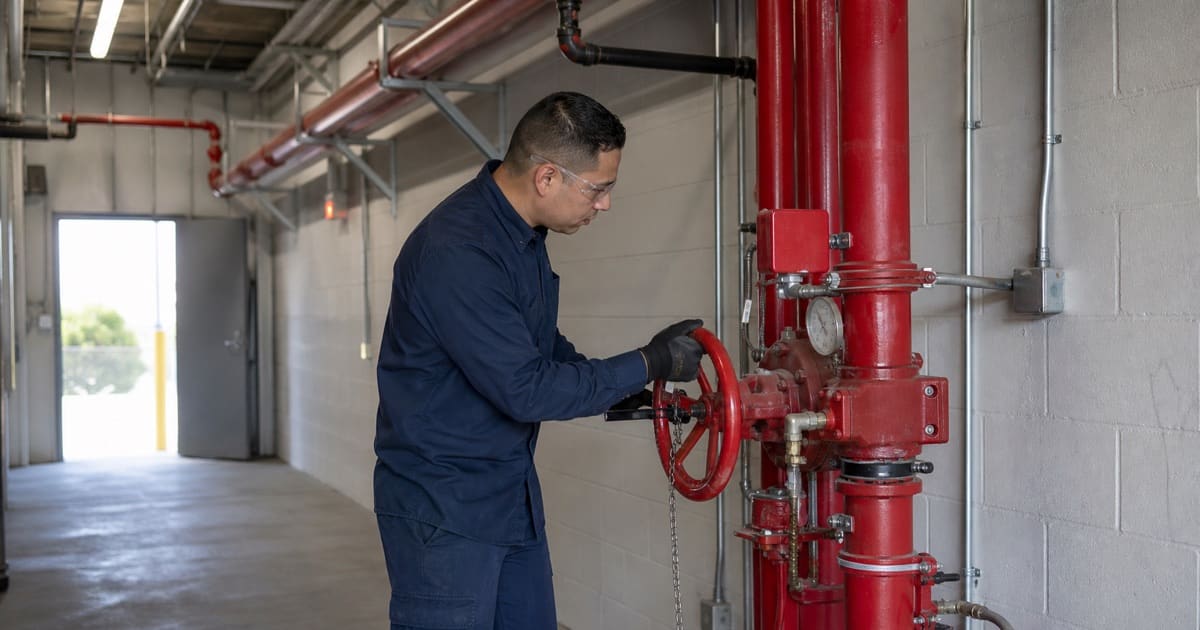
Commercial Fire Suppression in Long Beach, CA

Sprinklers, alarms, kitchen hood systems, and extinguishers inspected, repaired, and certified on schedule.

Long Beach Fire Suppression installs, inspects, and repairs commercial fire suppression systems throughout Long Beach, CA, covering fire sprinklers, fire alarms, kitchen hood systems, portable extinguishers, fire pumps, and backflow assemblies. We work on commercial and industrial buildings only, so warehouse, restaurant, and manufacturing schedules are never competing with residential calls for the same crew.

Most of the work we do starts with a date rather than a problem. A sprinkler certification comes due, a fire alarm needs its annual test, a hood system is past its semiannual service, or an inspector leaves behind a correction notice with a deadline attached. We track those due dates for the properties we service so annual and semiannual deadlines are met on schedule instead of surfacing during an inspection.

The other half is the part nobody plans for: a system that trips, a panel in trouble, a head that has to be replaced before a tenant can reopen. We handle impaired systems and failed inspections directly, and the crew that performs the inspection is the crew that completes the repairs, so nothing is handed to a subcontractor who has never seen the building.

Get Your Free Quote

Fast response • No obligation

So we can reach you about your request.

So we can send you a confirmation after you submit this inquiry form.

  • Commercial & Industrial Only
  • Code-Cited Inspection Reports
  • Emergency Impairment Response

What we do

Our Services

Commercial fire suppression and life safety systems in Long Beach

Installer tightening a coupling on new overhead sprinkler piping

Fire Sprinkler System Installation

Commercial fire sprinkler system installation in Long Beach, CA — wet pipe, dry pipe, pre-action, and ESFR systems designed, permitted, and tested.

Technician testing a sprinkler control valve during an NFPA 25 inspection

Fire Sprinkler Inspection

NFPA 25 commercial fire sprinkler inspection in Long Beach, CA — annual, semi-annual, and five-year requirements tracked and documented.

Technician replacing a sprinkler head on overhead branch line piping

Fire Sprinkler Repair

Commercial fire sprinkler repair in Long Beach, CA — emergency response, impairment handling, and inspection deficiency correction.

Technician servicing a wet chemical suppression nozzle in a commercial kitchen hood

Kitchen Hood Fire Suppression

Commercial kitchen hood fire suppression in Long Beach, CA — Ansul R-102 and Pyro-Chem service, recharge, and semi-annual inspection.

Technician mounting a serviced fire extinguisher during annual maintenance

Fire Extinguisher Service

Commercial fire extinguisher service in Long Beach, CA — NFPA 10 inspection, annual maintenance, recharge, and hydrostatic testing.

Technician landing wiring inside an addressable fire alarm control panel

Fire Alarm Systems

Commercial fire alarm system installation in Long Beach, CA — addressable and conventional panels, detection, notification, and monitoring.

Technician inspecting clean agent cylinders protecting a server room

Clean Agent Fire Suppression

Clean agent fire suppression in Long Beach, CA — FM-200, Novec 1230, and CO2 systems for data centers, server rooms, and equipment spaces.

Technician testing the discharge valve on a commercial fire pump

Fire Pump & Standpipe Testing

Commercial fire pump testing and standpipe inspection in Long Beach, CA — annual flow testing, churn testing, and five-year hydrostatic.

Technician connecting a test kit to a reduced pressure zone backflow assembly

Backflow Testing

Commercial backflow testing and certification in Long Beach, CA — DCVA and RPZ assemblies on fire sprinkler systems, tested and repaired.

Why Choose Long Beach Fire Suppression

Technician inspecting a commercial fire sprinkler riser and control valve

Commercial and Industrial Fire Protection Only

We do not run a residential division, which means sprinkler, alarm, and suppression work for commercial buildings is the whole business rather than the overflow. Warehouses, kitchens, and manufacturing floors get crews who work on those systems every day and understand how a shutdown affects operations. After-hours access and tenant coordination are priced in, not treated as exceptions.

Inspection Reports That Cite the Code Section

Every deficiency we note comes with photo documentation and the code section behind it, so a building owner can see what was found and why it matters. That turns an inspection report into something you can hand to an inspector, a landlord, or an insurance carrier without translating it first. Deficiencies are priced separately, so urgent corrections can be approved without waiting on the rest.

Emergency Response for Impaired Systems and Failed Inspections

When a fire suppression system goes out of service, the building is on a clock and often on a fire watch until it is restored. We respond to impairments and failed inspections as their own category of work rather than fitting them into the next open maintenance slot. Restoring service and lifting the fire watch comes first; the paperwork follows.

Sprinklers, Alarms, Extinguishers, and Hood Systems Under One Contract

Splitting fire protection across four vendors means four schedules, four invoices, and four different answers when something fails. We handle water-based systems, detection, portable extinguishers, and kitchen suppression together, which also removes the argument about whose scope a deficiency belongs to. It also collapses four inspection calendars into one, sequenced into as few visits as the intervals allow.

Scheduling Built Around Your Operating Hours

Kitchens, warehouses, and storefronts lose money when fire system work closes them down, so we schedule around service hours rather than defaulting to a weekday morning. Access and shutdowns are coordinated directly with property managers, owners, and tenants, so nobody discovers a riser is drained at the start of a shift. Multi-site operators get one trip covering several properties on a shared reporting cycle.

Fire System Inspections and Code Compliance

NFPA 25 Inspection, Testing, and Maintenance

NFPA 25 is the standard that governs water-based fire protection, and it sets separate schedules for gauges, valves, alarm devices, and the system as a whole. We run those inspections on their required intervals and document each one, so the record shows a system maintained on schedule rather than a single annual visit standing in for everything. Deficiencies are corrected by the same crew, so nothing waits on a second contractor’s schedule.

The Long Beach Fire Protection and Life Safety Certification Program

Long Beach administers its own certification program for fire protection and life safety equipment, with testing intervals and reporting requirements set by the local fire department. Building owners are frequently told to comply with a neighboring jurisdiction’s program by mistake, and we file against the requirements that actually apply here. We prepare and submit the certification paperwork on the intervals the program sets.

Five-Year Sprinkler Certification and Internal Obstruction Investigation

Beyond the annual visit, water-based systems carry longer-cycle requirements including the five-year internal obstruction investigation, which opens the piping to check for scale, sediment, and corrosion products. These are the tests owners most often discover late, because four years can pass with nothing on the calendar. We schedule them ahead of the due date, because an obstruction finding needs room for follow-up work.

Annual Fire Alarm Inspection and Title 19 Certification

Fire alarm systems carry their own annual test and certification requirements under California Title 19, separate from anything on the sprinkler side and often held by a different contractor. We test the panel, the initiating devices, and the notification circuits, then issue the certification the fire department expects to see. Servicing both sides means the sprinkler-to-alarm interfaces get verified on the same visit.

Hood System Service Intervals Based on Cooking Volume

NFPA 96 ties commercial kitchen exhaust cleaning frequency to how much and what a kitchen cooks, so a high-volume operation running solid fuel is on a very different schedule than a low-volume kitchen. We set the interval against actual cooking volume rather than defaulting every restaurant to the same visit. That keeps a low-volume kitchen off an aggressive schedule and a busy one out of violation.

Extinguisher Annual, Six-Year, and Hydrostatic Testing

Portable extinguishers need an annual service, a six-year internal maintenance, and hydrostatic testing at longer intervals depending on cylinder type. Tags are the first thing an inspector checks because they are the easiest thing to check, and an expired tag on a mounted extinguisher is a citation waiting to be written. We flag units nearing hydrostatic test or end of life before they become a finding.

Fire Clearance for a Long Beach Business License

A business license application can stall at the fire clearance step when the building’s fire protection equipment is not current or a prior correction was never closed out. We inspect against what the clearance actually requires and correct what is outstanding, which is usually faster than discovering the problem after an application is already filed. We correct what the inspection turns up and provide the documentation the clearance requires.

Sprinkler Plan Check and Tenant Improvement Permits

Moving walls moves sprinkler heads, and beyond a small number of relocated heads that becomes a plan check submittal rather than a field adjustment. We prepare the sprinkler and standpipe drawings a tenant improvement needs and handle the permit process, so the fire portion is not the item holding up an occupancy date. We coordinate the rough and final inspections so the fire scope tracks the rest of the build-out.

Fire Sprinkler Systems, Pumps, and Water Supply

Wet pipe sprinkler riser with control valve and pressure gauges

Wet Pipe Sprinkler Systems

Wet pipe is the most common commercial arrangement, holding water in the piping at all times so a head that operates discharges immediately. Maintenance centers on the riser, control valves, gauges, and flow and tamper switches, and most of what shortens a wet system’s life is a valve nobody exercised or a gauge nobody replaced. We exercise the valves, replace failed gauges and heads, and repair the fitting leaks age brings.

Dry pipe valve and air compressor on an unheated warehouse system

Dry Pipe Systems and Annual Trip Testing

Dry pipe systems hold pressurized air instead of water, which suits unheated warehouses, loading docks, and freezer spaces where standing water would freeze. They carry a trip test requirement to confirm the valve actually operates, and they are prone to internal corrosion because air and residual moisture sit in the pipe together. We service the compressor and dry valve and address the low points where corrosion starts.

Pre-action valve assembly with its release panel

Pre-Action and Deluge Systems

Pre-action systems require a detection event before water enters the piping, which protects spaces where an accidental discharge would be expensive, while deluge systems flow from open heads across an entire area at once. Both depend on a detection system and a release panel, so servicing them means testing the electronics alongside the pipe. A system that passes a pipe inspection but has a failed release is not protecting anything.

ESFR pendent sprinklers above high-piled warehouse racking

ESFR Sprinklers for High-Piled Warehouse Storage

Early suppression fast response heads are designed to control a fire in high-piled storage from the ceiling, which can eliminate in-rack piping when the design matches the commodity and rack arrangement. Storage height, aisle width, and what is actually on the racks all affect whether an existing ESFR design still holds after a tenant changes. We handle the high-piled storage permit and sprinkler changes when a tenant’s commodity shifts.

In-rack sprinkler piping running inside storage racking

In-Rack Sprinkler Protection

Where ceiling-only protection cannot reach the seat of a fire, sprinklers are installed inside the racking itself, close to the stored commodity. In-rack piping takes physical abuse from forklifts and pallet movement, so inspections concentrate on damaged heads, bent piping, and protection that was removed during a racking reconfiguration. We replace heads lost to forklift traffic and reinstate protection pulled during a rack reconfiguration.

Fire pump and controller during an annual flow test

Fire Pump and Jockey Pump Testing

Buildings that cannot get adequate pressure from the city main rely on a fire pump, and that pump carries weekly and annual test requirements including a flow test against its performance curve. The jockey pump maintains system pressure between demands, and a jockey pump cycling constantly is usually pointing at a leak somewhere in the system. We run the churn and flow tests, service the controller, and trace the leak behind constant cycling.

Fire department connection and standpipe outlet on a commercial building

Standpipe and Fire Department Connection Testing

Standpipes give firefighters water on upper floors, and the fire department connection is how they augment the system from the street. Both carry flow testing and hydrostatic requirements at longer intervals, and both fail in unglamorous ways: missing caps, damaged threads, obstructed connections, and pressure-regulating valves nobody has verified. We service pressure-regulating valves and repair the caps, threads, and connections crews need on arrival.

Technician testing a reduced pressure zone backflow assembly on a fire line

Backflow Preventer Testing on the Fire Line

The backflow assembly on a fire service line protects the potable water supply and is typically tested annually by a certified tester. Double check and reduced pressure zone assemblies fail differently, and a fire line backflow is easy to overlook because it is often tracked by the water purveyor rather than the fire department. We file results with the agency that requires them, so the assembly is not missed by both.

Fire Alarm, Detection, and Monitoring

Addressable Fire Alarm Panels

Addressable panels identify the specific device in alarm rather than just the zone, which turns a building-wide search into walking to a known device. We service, program, and replace addressable systems, and on older buildings we deal with the practical problem of a panel still in service long after its parts stopped being manufactured. Where parts are gone, we plan a phased replacement instead of running on salvaged components.

Alarm Monitoring and Cellular Communicators

Monitored systems transmit alarm, supervisory, and trouble signals to a central station, and copper phone lines that once carried those signals are largely gone. Cellular and IP communicators have replaced them, and a building still relying on a disconnected line is monitored on paper only. We verify signals actually reach the central station and migrate buildings off retired copper service.

Smoke and Duct Detector Sensitivity Testing

Smoke detectors require periodic sensitivity testing to confirm they still respond within their listed range, since dust, grease, and age all drift a detector out of specification. Duct detectors sit inside air handling equipment to shut down fans and stop smoke moving through a building, and they are the ones most often found dirty. We clean or replace detectors that have drifted and service duct units so fan shutdown still works.

Horn Strobe and Notification Appliances

Notification appliances have to be audible and visible throughout the occupied space, which is why a tenant improvement that adds walls frequently invalidates the existing layout. We test notification circuits, verify coverage after a space changes, and replace appliances that no longer meet the synchronization the system requires. We recalculate coverage after a reconfiguration and relocate appliances to keep the floor compliant.

Emergency Responder Radio Coverage Testing

Many buildings are required to demonstrate that fire department radios work throughout the structure, and concrete, metal decking, and below-grade levels are what usually defeat them. Testing identifies the dead areas, and buildings that fail generally need a signal booster system that then carries its own annual testing obligation. We document results for the fire department and service the booster systems failing buildings need.

Elevator Recall and Fire Service Testing

Elevator fire service recall ties the alarm system to the elevator controller so cars return to a designated floor rather than opening on a fire floor. It is tested as an interface between two systems maintained by two different contractors, which is exactly why it is so often found not working. We coordinate with the elevator contractor when the fault is theirs, so it does not stay unresolved.

Carbon Monoxide Detection

Carbon monoxide detection is required in buildings with fuel-burning equipment or attached garages, and the sensors have a service life that ends whether or not the device still powers up. We test CO devices and replace them at end of life, since a detector past its listed lifespan is not a functioning safeguard. We track end-of-life dates with the rest of the building’s calendar and replace units before they expire.

Mass Notification Systems

Mass notification extends the alarm system into voice messaging so occupants receive specific instructions instead of a generic tone. These systems are common on campuses, in larger facilities, and anywhere evacuation is not the automatic answer, and they require intelligibility testing rather than a simple sound level reading. We handle the intelligibility testing these systems require and maintain the messages they broadcast.

Kitchen Hood and Special Hazard Suppression

Ansul R-102 wet chemical cylinder and nozzles above a commercial cook line

Ansul R-102 Kitchen Hood Systems

The R-102 wet chemical system is the most common kitchen hood suppression arrangement in commercial kitchens, discharging a low pH agent that saponifies on the surface of hot cooking oil. Service covers the nozzles, fusible links, the regulated release assembly, and the cylinder, and nozzle positioning has to match the appliances actually installed underneath. We recharge and recommission after a discharge so a kitchen gets back into service quickly.

Pre-UL 300 kitchen suppression system being replaced

UL 300 Upgrades for Older Kitchen Systems

Kitchen systems built before the UL 300 standard used dry chemical agents that cannot reliably suppress a fire in modern high-efficiency fryers. A pre-UL 300 system is a common inspection finding, and the correction is a system replacement rather than a repair, which is worth knowing before an inspector puts it in writing. We design the replacement around the appliance line installed, avoiding a second round of nozzle changes.

Class K wet chemical extinguisher mounted beside a fryer line

Class K Wet Chemical Extinguishers

Class K portable extinguishers are required in kitchens with cooking oil hazards, backing up the hood system rather than replacing it. They carry their own annual service, and the placard directing staff to activate the hood system before using the extinguisher is part of the required installation. We confirm placement and placarding, so the unit is not technically present but non-compliant.

Clean agent cylinders protecting a server room

Clean Agent Suppression for Server Rooms

Clean agent systems protect electronics with a gas that suppresses fire without leaving residue, which is why they are used where a water discharge would destroy more than the fire. Agents including FM-200 and Novec 1230 are common, and cylinders are weighed on a set interval and hydrostatically tested at longer ones. We service the detection and release electronics and recharge with the agent the hardware expects.

Inert gas cylinder bank for a special hazard suppression system

Inergen and Inert Gas Suppression Systems

Inert gas systems work by reducing the oxygen concentration in a protected space to a level that will not sustain combustion while remaining survivable for occupants. They store as compressed gas rather than a liquefied agent, which means more cylinders and a discharge that requires room pressure venting to be properly sized. We verify room pressure venting is intact, since a sealed room can be damaged by its own discharge.

CO2 suppression cylinders on an industrial hazard

CO2 and Dry Chemical Special Hazard Systems

Carbon dioxide systems remain in use on specific industrial hazards, and because CO2 suppresses by displacing oxygen they carry occupant safety requirements that clean agents do not. Dry chemical special hazard systems still protect certain equipment and processes, and both need discharge testing and cylinder maintenance on schedule. Where a dry chemical system no longer suits the hazard, we scope the replacement rather than maintain it.

Suppression nozzles inside a spray finishing booth

Paint Booth and Spray Booth Suppression

Spray application areas concentrate flammable vapors and combustible residue, and the code recognizes several suppression approaches depending on how the booth is built and used. Overspray accumulation on nozzles is the recurring problem, because a nozzle caked in cured material will not distribute agent where the design intended. We work around finishing schedules so a booth is not out of production longer than it has to be.

Onboard fire suppression on heavy yard equipment

Vehicle and Heavy Equipment Fire Suppression

Yard trucks, container handlers, and heavy equipment carry onboard suppression aimed at engine compartments and hydraulic lines, where a leak onto a hot surface is the usual ignition path. These systems live in constant vibration and heat, so detection tubing, nozzles, and actuators need inspection on a schedule that reflects that. We recharge and recommission after an actuation so equipment returns to the yard protected.

Areas We Serve

Long Beach Fire Suppression provides fire suppression throughout the greater Long Beach area, with the same crews and the same standards on every job.

Good to know

Frequently Asked Questions

Which systems in our building have recurring inspection deadlines?

Usually more than an owner expects. Sprinklers, fire alarms, kitchen hood suppression, portable extinguishers, fire pumps, standpipes, and backflow assemblies each carry their own schedule, and they rarely line up on the same date. Some are annual, some semiannual, and some run on five-year or longer cycles, which is why the long-interval items are the ones most often missed. We build a single calendar per property covering all of them.

What happens if our building fails a fire inspection?

A failed inspection normally comes with a written correction notice and a limited window to fix what was found. We inspect, price each deficiency separately so the work can be staged by budget where the timeline allows, and complete the corrections with the same crew, then document the work in a form you can return to the inspector.

Our kitchen hood system discharged. What do we do before reopening?

Stop cooking on the affected line and get the system recharged and put back in service before anything restarts, since the kitchen is unprotected until it is. A discharge usually also involves cleaning the wet chemical agent off surfaces and appliances, and depending on your jurisdiction the health department may need to clear the kitchen before you reopen.

Do we need a fire clearance to get a business license in Long Beach?

Business license approval commonly depends on a fire clearance, and that clearance depends on the building's fire protection equipment being current. Applications stall most often because an extinguisher tag expired, an alarm certification was never filed, or a previous correction notice was never closed out.

What is a fire watch, and when do we need one?

A fire watch is a trained person patrolling the affected area on a set route while a fire protection system is out of service. It is generally required from the moment a system becomes impaired until it is restored, and it applies whether the system went down from a failure or from planned work.

Why does our fire alarm panel keep beeping?

A panel beeping without an alarm is usually signaling a trouble or supervisory condition rather than a fire. Common causes are a low backup battery, a communication failure, a dirty detector, or a tamper switch on a valve that was moved. A tamper signal deserves immediate attention because it can mean a control valve is partly closed.

How much does a commercial fire inspection cost?

It depends on what is being inspected and how big it is, since head count, device count, and the number of risers and systems all drive the labor involved. Buildings with a fire pump, a standpipe, or multiple system types cost more than a single small wet system. We quote against the actual building rather than a flat rate.

Does our older kitchen suppression system need to be replaced?

If the system predates the UL 300 standard and uses a dry chemical agent, it generally has to be replaced rather than repaired, because the older agents do not reliably suppress fires in modern high-efficiency cooking appliances. This is one of the most common findings in older restaurant spaces and is worth checking before an inspection does.

How long does a sprinkler permit take for a tenant improvement?

It depends on whether the work qualifies as a field adjustment or requires a plan check submittal, which turns largely on how many heads are being relocated and whether the layout changes. We prepare the drawings, submit them, and coordinate the inspection so the fire portion does not become the item delaying occupancy.

Can one contractor handle sprinklers, alarms, extinguishers, and hood systems?

Yes, and consolidating them removes the scheduling and scope problems that come with running four vendors against one building. It also removes the common situation where a deficiency sits uncorrected because two contractors each consider it the other's scope.

Ready to Get Started?

Request a free quote today and we'll get back to you fast.